64.87
Atlanta


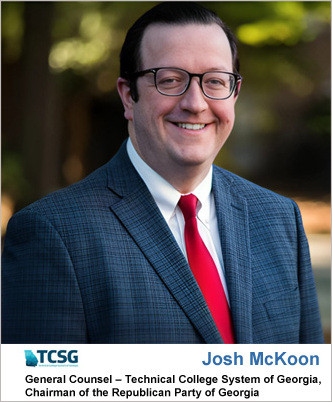

Serving as Georgia Republican Party Chairman while working full time as General Counsel to the Technical College System of Georgia keeps Josh McKoon busy. Each of these demanding positions requires different areas of focus and presentsunique challenges, but both allow Josh to focus on one of his favorite passions - creating opportunity for Georgians.
Interest in politics begins at an early age for most people, and that was certainly the case with Josh McKoon. While attending Furman University in South Carolina, he managed the political campaign of Trey Gowdy for district attorney. Gowdy became famous for many appearances on true crime television show “Forensic Files,” later becoming a US
Congressman. Josh also worked as a field director for the 2000 George W. Bush campaign for president.
“It was exciting,” says Josh, “helping to coordinate a national political campaign. Secret Service were everywhere. Bush desperately needed to win the South Carolina presidential primary to get the Republican nomination. I’m proud to say that I had something to do with making that happen.”
Born and raised in Columbus, Georgia, Josh notes that his family’s history played a role in the path he has taken. His forefathers arrived in Georgia in the early 1900s from North Carolina. “Similar to today, the Georgia job growth engine brought my ancestors to the state,” he says. “With work hard to find in North Carolina, one brother came to Columbus and found work in a mill. Two brothers followed, and all three brothers became Georgia residents.”
Josh’s grandfather became a conductor on the Georgia & Central Railroad, delivered ice, and fought in World War II. He also became something of a serial entrepreneur, opening a grocery store, a gas station and then finishing with a laundromat.
Josh’s father was the first in his family to go to college. His parents met at Auburn and both were always interested in politics. “Columbus is on the state line with Alabama and my mother worked for the Russell County, Alabama DA’s office,” says Josh. “My father became a lawyer, so I basically grew up around courthouses.”
Knowing that he also wanted to become a lawyer, Josh studied political science and communications at Furman, working through school most of the time that he was in attendance. “I worked at Mori Luggage and Gifts, dealing with customers from
all walks of life. Handling a wide cross section of people taught me a lot about life,” he says.
After graduating from Furman, Josh was offered a scholarship to attend law school at the University of Alabama. “I was flattered when the Dean of the law school called to tell me how much they wanted me to come,” says Josh, “but really what got my attention was the fact that the scholarship came with a laptop computer. This was 2001.”
He interned at a large law firm in Columbus for both years, then accepted an offer to join the firm upon graduation. He continued at the firm for several years, focusing on banking law and litigation. Josh’s father, still an attorney practicing in Columbus, got a big case defending Continental Carbon, which had been accused of spewing carbon black, causing
damage to health and property. “I left the firm to help Dad with the case, working for him for five years,” he says. “I was in the courthouse constantly. It was great litigation experience.”
Around this time, Josh became highly involved in an important local issue. The consolidated government of Columbus had decided to build a beautiful new library in a blighted area of the city and promoted the project as one that would not only create the library but also fund badly needed landscaping on the surrounding 40 to 50 acres of cracked asphalt and broken glass – turning it into a park.
“After the library building was completed, the consolidated government of Columbus announced that there was no money left for landscaping,” said Josh. “This was frankly a disaster. Some local business leaders and I investigated the matter and found that they had $6 million left over. When we pointed this out, they said that they were not obligated to spend the money on landscaping.”
With Josh acting as their attorney, leading citizens of Columbus sued. The trial court ruled that they did not have standing to sue. The Georgia Court of Appeals agreed. “We had no choice but to take this to the Georgia Supreme Court,” said Josh.
“Even though the $6 million remaining was less than has been planned for landscaping, we were able to get advice and guidance from Callaway Gardens on how best to use the remaining money to do the best possible job.”
The Georgia Supreme Court unanimously reversed, and they were able to get the greenspace, a win for the community and people of Columbus that helped shape Josh into the man he is today.
Josh returned to politics as a young adult, becoming chairman of the Muscogee County Republican party in 2009. “At nearly the same time, the state senator for Muscogee County decided to run for state Insurance Commissioner in 2010,” he says. “He asked to meet with me and told me that I should run for his state senate seat. I announced my campaign in June of 2009.”
With the help of many local civic and business leaders, no Republican opposition, and only token opposition from local Democrats, Josh was elected to the Georgia state senate in 2010. During his two full terms in the state senate, Josh was most proud of his constituent service. “Making sure that citizens received the benefits that they were entitled to is always gratifying,” says Josh, “but I think just as important is making sure that they are heard and taken seriously. I can’t think of anything more important in a representative democracy.”
He also had no trouble ruffling feathers when he thought something was not right. Wanting more transparency in government, Josh thought state senate committees should stream their meetings. When he brought it up, he was told that they neither had the time nor the budget to make committee meetings available via streaming. “Yes, committee meetings were open to the public,” said Josh, “but not everyone has the time to drive from the far reaches of Georgia – or even from Atlanta – to attend a meeting at the Georgia State Capitol.” Using his own phone, Josh started to stream committee meetings by himself.
“You won’t believe how quickly state senate leaders found the $2 million needed to wire all the committee meeting rooms for streaming,” says Josh.
Other items that made Josh somewhat unpopular with senate leadership included trying to make proposed amendments available to read faster and giving the legislature an extra hour to review Conference Committee reports. “I firmly believed that a state like Georgia – with abbreviated legislative sessions – needed to make the most efficient use of lawmaker time,” he said.
In 2018 Josh ran for the office of Secretary of State of Georgia and came in third in the primary, barely missing the runoff. He decided that he wanted to stay involved in politics, but not as a front person. He was asked to run for Georgia state Republican Party Chairman and was elected in June of 2023 and reelected in 2025.
“My first big issue was dealing with Fulton DA Fani Willis’s prosecution of President Trump and his advocates. The historic nature of this matter made me want to be a front man again. While reasonable people can differ, I have a real problem with any attempt to criminalize politics at the expense of taxpayers,” says Josh. “Fortunately, the unethical nature of that prosecution was exposed and the whole thing dismissed recently.”
As party chairman, Josh works to get people rowing in the same direction. “This is still a center-right state,” says Josh, “but elections now are much closer. It’s not 60/40 anymore so it's critical Republicans work together.” As a practicing lawyer who is involved in politics, Josh says that it has always been a struggle to find the right balance between legal work and political work, but as General Counsel of the Technical College System of Georgia, he believes that he has found that balance.
“I started working at the Technical College System of Georgia in 2020,” says Josh. “This entity plays a vital role in workforce development for the state. The 22 schools provide hands-on training that allows the state of Georgia to win modern new car manufacturing plants and advanced manufacturing in other industries. Since Covid, there has been double digit growth in high demand jobs like these and others.”
Josh believes that workforce development will have to be taken more seriously in the future by all states. “We need to think about workforce development the same way we look at available land, available electricity, or available capital,” says Josh. “If you aren’t working to develop your workforce, you aren’t going to grow.”
The work is different from his previous legal work, but just as important. “I don’t go to court anymore. Most of my time is spent advising the Commissioner of the Technical College System of Georgia and the individual schools. But it’s so gratifying to hear how these schools have changed the lives of students for the better,” he says.
“The system has something called the Eagle Program, which recognizes the best student from each of the 22 schools. I remember one student, a nurse, who excelled, and it changed the lives of her entire family. Not only did she get a good job at a hospital, but other family members found work there as well,” he says, “I’m proud of that.”
Georgia will be central to the national conversation in the 2026 election, says Josh, and an incredibly consequential question is on the ballot. “Do we want to continue the last 20 years of astonishing economic growth? Who are the best people to keep that going,” he asks.
“Only 50,000 votes probably swing Georgia elections either way for the next ten years,” he says. “It will certainly be competitive.”

© Copyright 2026, All Rights Reserved